
Joomla guide v1.2.6
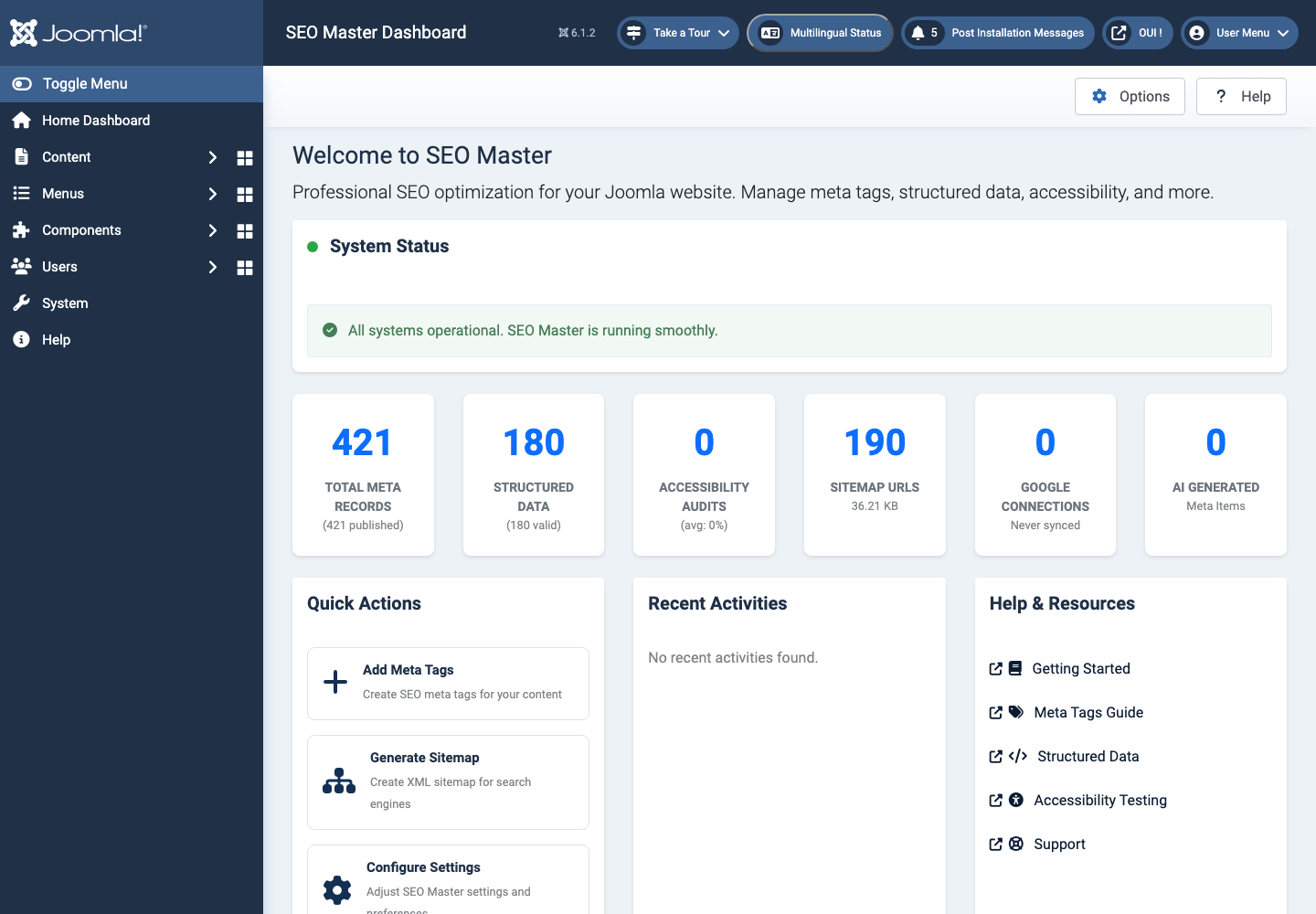
Centralise every SEO lever in Joomla: meta tags, structured data, sitemaps, Search Console, AI, WCAG accessibility and a REST API. 7 plugins, 11 database tables.
Overview
Centralise every SEO lever in Joomla: meta tags, structured data, sitemaps, Search Console, AI, WCAG accessibility and a REST API. 7 plugins, 11 database tables.
Requirements
- Joomla 4.4, 5 or 6 depending on the package version.
- PHP 8.1 or later is recommended.
- A recent backup before installation or update.
Installation
- Download the ZIP package and do not extract it.
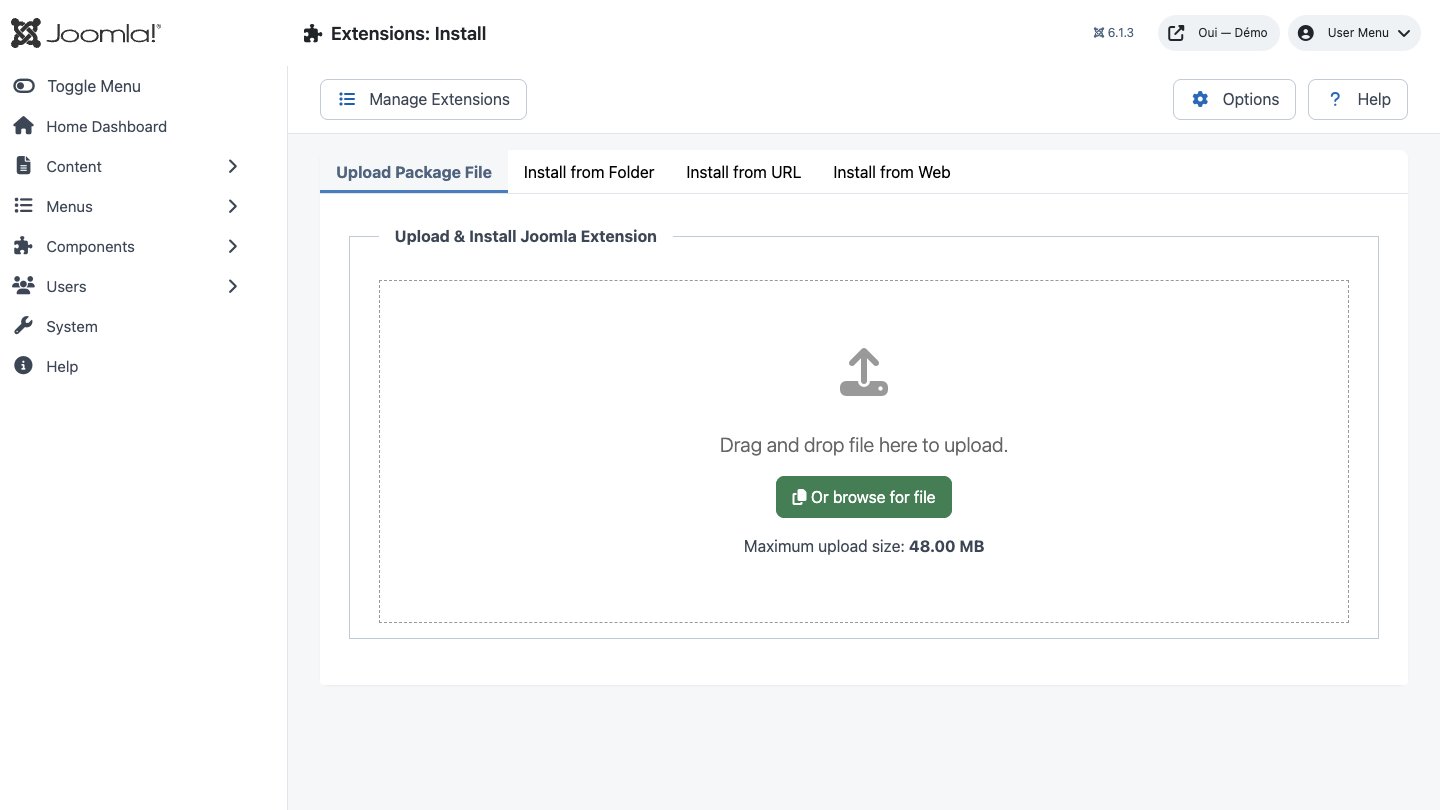
- In Joomla, open System → Install → Extensions.
- Drop the ZIP into the installation area and wait for the confirmation message.
- Open the component from Components. If the package includes a plugin, check its status under System → Manage → Plugins.
- Review component permissions before opening it to the team.
Initial configuration
- Open the extension dashboard.
- Open Options and review global settings.
- Grant Create, Edit, Delete and Configure permissions to the appropriate groups.
- Create a first test item and check the frontend when a public view is provided.
- Enable bundled plugins or scheduled tasks only when they are needed.
Features
Meta tags, Open Graph & Twitter
Title, description, keywords, robots directive and canonical URL for every item. Open Graph fields (title, description, image, type) and Twitter Card fields are stored separately, never guessed.
Schema.org structured data
A JSON-LD editor with 18 ready-made Schema.org types: Article, NewsArticle, Product, FAQ, HowTo, Recipe, Event, LocalBusiness, JobPosting, Course, VideoObject and more. Every block can be generated automatically or written by hand.
Menu-driven XML sitemaps
You decide menu by menu what goes into the sitemap, with its own priority and change frequency. Article images are added through Google's image: namespace, and the generated file is validated before it is published.
Google Search Console
OAuth 2.0 connection, with access and refresh tokens kept encrypted in your own database. Clicks, impressions, CTR and average position are imported per query, per device and per country.
AI content generation
Draft titles, meta descriptions and structured-data blocks in one click. Five providers to choose from: OpenAI, Anthropic Claude, Google Gemini, Cohere, or an Ollama model running on your own hardware.
WCAG accessibility auditing
Scan your pages at level A, AA or AAA. Each page gets a score out of 100 and every issue is graded across four severity levels, with the WCAG criterion, the offending selector, a recommendation and a help link.
Internal linking (Netlinks)
Set an expression, a target and the rules around it: maximum replacements per page, case sensitivity, whole-word matching, rel attribute (nofollow, sponsored, ugc) and a publishing window. An insertion counter tracks how often each rule fires.
Broken-link detection
One of the package's six scheduled routines walks your internal and external links from Joomla's native task scheduler. You fix the 404s before they start costing you rankings.
First steps
- Start with a simple use case and non-sensitive data.
- Validate the result with the team that will use the extension.
- Record site-specific choices such as roles, automations, templates and integrations.
- Roll out gradually, then monitor logs and user feedback.
Screenshots
Troubleshooting
- The extension does not appear after installation
- Check the installer message and the component/plugin status, then clear Joomla or WordPress caches.
- An action is denied
- Review the user group permissions, session token and any security restrictions.
- The output does not match the site
- Test with caching disabled, inspect template overrides and look for CSS or JavaScript conflicts.
- An external integration fails
- Check the URL, credentials, quotas and logs without copying secrets into a support request.
Updating and uninstalling
Before updating, back up files and the database, read the release notes, and test on a copy of the site. Export useful data before uninstalling. Removing a package may remove several related components, modules or plugins.