
Joomla guide v1.0.0
AI Content wires Joomla to seven AI engines using your own encrypted keys: editor assistant, reusable prompt templates, images and scheduled batch jobs.
Overview
AI Content wires Joomla to seven AI engines using your own encrypted keys: editor assistant, reusable prompt templates, images and scheduled batch jobs.
Requirements
- Joomla 4.4, 5 or 6 depending on the package version.
- PHP 8.1 or later is recommended.
- A recent backup before installation or update.
Installation
- Download the ZIP package and do not extract it.
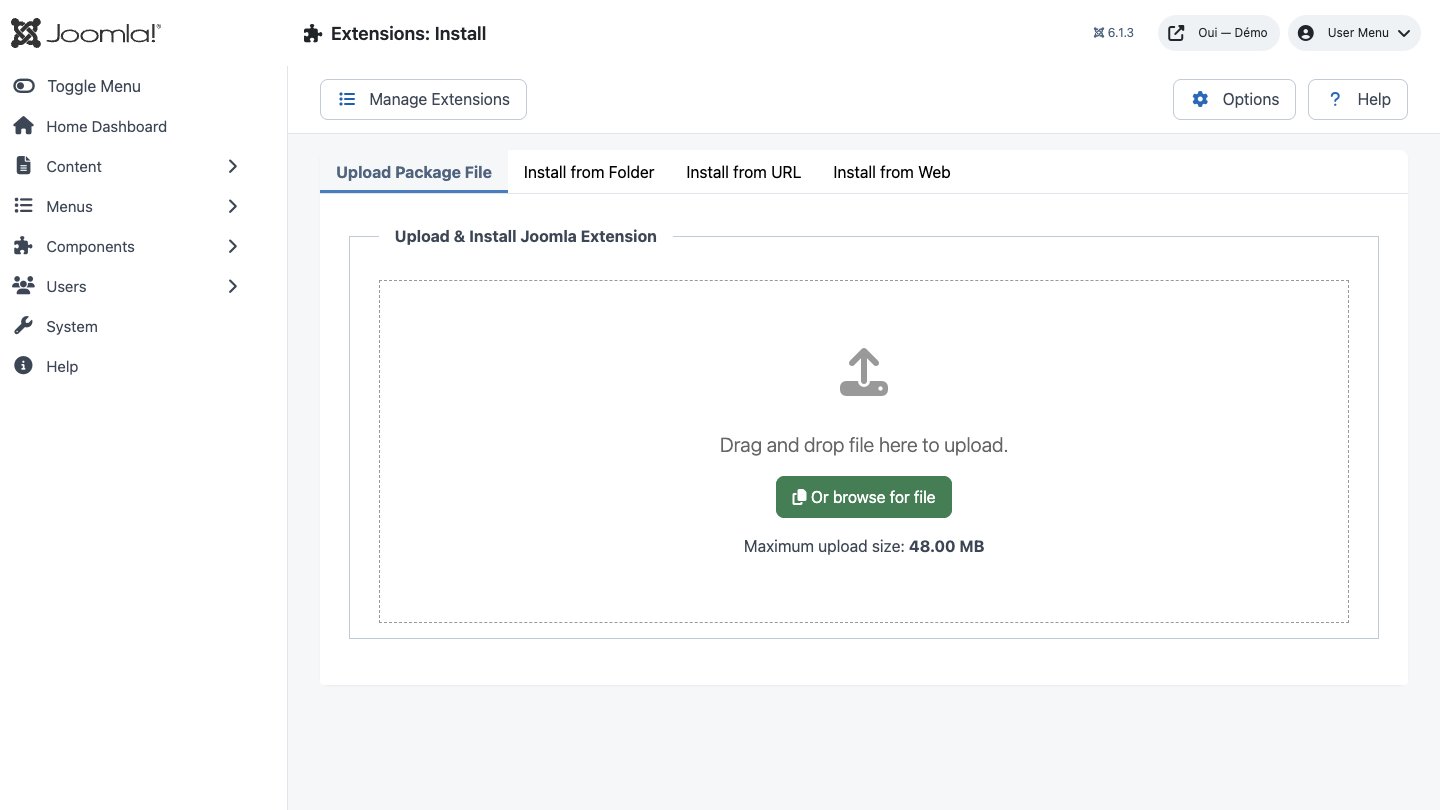
- In Joomla, open System → Install → Extensions.
- Drop the ZIP into the installation area and wait for the confirmation message.
- Open the component from Components. If the package includes a plugin, check its status under System → Manage → Plugins.
- Review component permissions before opening it to the team.
Initial configuration
- Open the extension dashboard.
- Open Options and review global settings.
- Grant Create, Edit, Delete and Configure permissions to the appropriate groups.
- Create a first test item and check the frontend when a public view is provided.
- Enable bundled plugins or scheduled tasks only when they are needed.
Features
AI assistant in the editor
A button joins your article editor's toolbar. It opens a modal where you pick a provider and a prompt template; the generated text arrives as a live stream and drops into the field with one click.
Reusable prompt templates
Every template bundles a system prompt, a user prompt and its own variable schema: up to 20 variables, 5 field types (text, textarea, number, select, date) and 7 output filters. Write the recipe once, let your editors replay it.
Seven provider drivers
OpenAI, Anthropic, Google Gemini, Mistral AI, Ollama running locally, any OpenAI-compatible endpoint, and AI Router, the OuiSi gateway. One driver interface throughout, so swapping engines never touches your prompt templates.
Automatic article context
Hand the renderer an article ID and it injects 11 fields (title, introtext, fulltext, metadesc, category, language, tags and more) alongside your Joomla custom fields, addressable as {{article.*}} and {{custom.*}}.
History and cost
Every call — successful, partial or failed — leaves a row in the generations table: the prompt sent, the response received, input and output tokens, cost in US dollars and latency in milliseconds.
Scheduled batches
A task plugin registers a routine with Joomla's scheduler. It finds articles whose target field is empty, generates the missing content and writes it back. Four permitted target fields, 50 articles per run by default, progress recorded on the job.
Install the package
One ZIP in the extension manager. The component and its 5 plugins are deployed, the 5 tables created, and the com_aicontent.template content type registered so version history works on your templates.
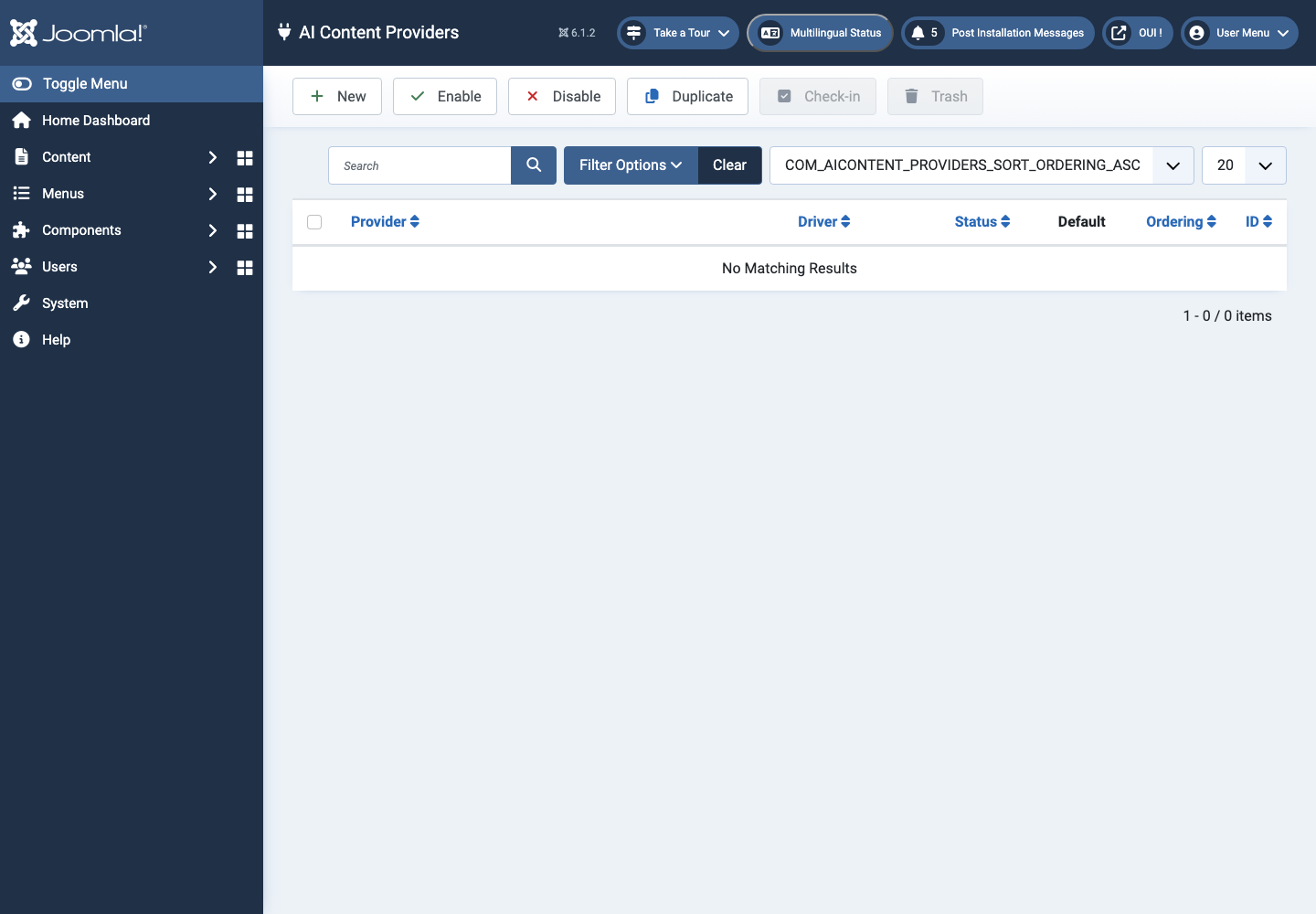
Declare a provider
Choose a driver, paste your API key, set the default model. A test button fires a minimal request and reports the latency and the tokens it consumed.
First steps
- Start with a simple use case and non-sensitive data.
- Validate the result with the team that will use the extension.
- Record site-specific choices such as roles, automations, templates and integrations.
- Roll out gradually, then monitor logs and user feedback.
Screenshots
Troubleshooting
- The extension does not appear after installation
- Check the installer message and the component/plugin status, then clear Joomla or WordPress caches.
- An action is denied
- Review the user group permissions, session token and any security restrictions.
- The output does not match the site
- Test with caching disabled, inspect template overrides and look for CSS or JavaScript conflicts.
- An external integration fails
- Check the URL, credentials, quotas and logs without copying secrets into a support request.
Updating and uninstalling
Before updating, back up files and the database, read the release notes, and test on a copy of the site. Export useful data before uninstalling. Removing a package may remove several related components, modules or plugins.